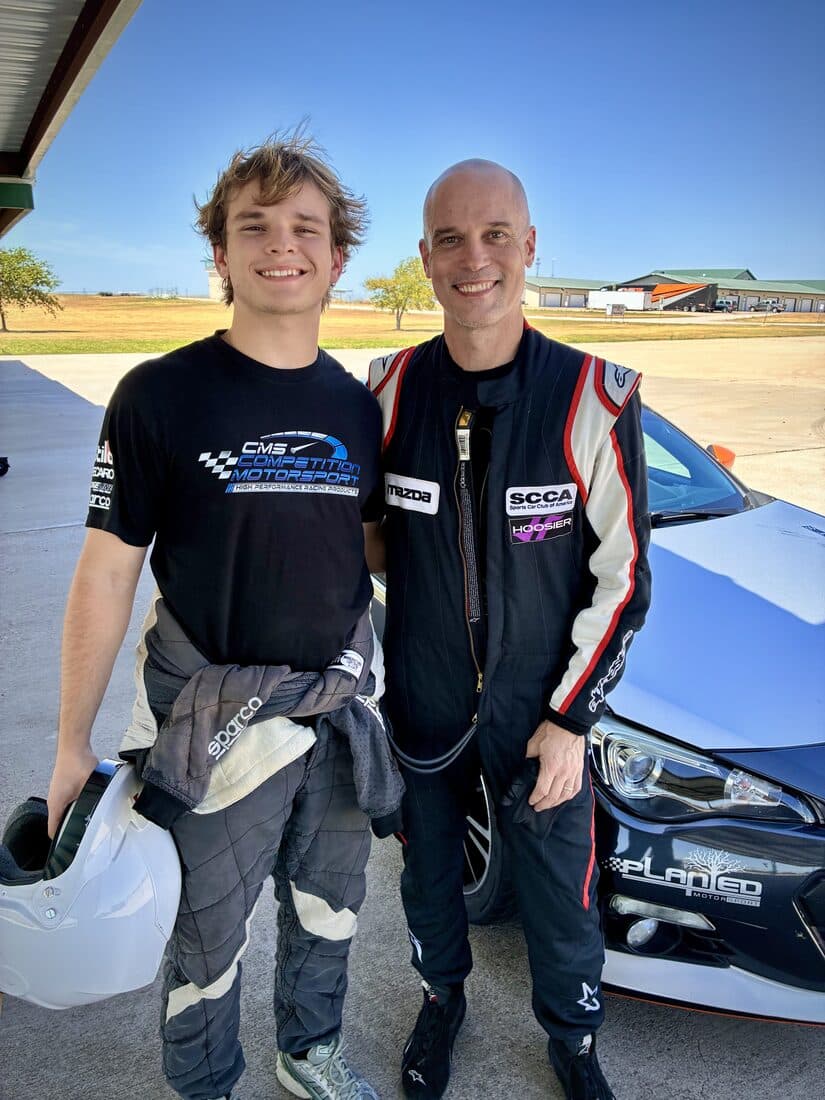
THE COMPETITION
The full field, driver by driver
All fifteen drivers, the segment times, the phase measurements and the thirty-second film from the day.
See the full fieldLesson · Data study · 5 min read
Fifteen drivers took the same BRZ through Little Bend, each one measured on a Garmin Catalyst. Two of those runs disagree with almost everything a driver is told about entry speed.
Speed you have to brake away is wasted speed.
Jon-Eric Fountain
Entered hard
Darryl Paul
Entered 5.2 mph slower
The short answer
Across fifteen drivers at one corner, the quickest solution came from the driver who arrived slowest. He carried 5.2 mph less into the corner than the coach, spent 0.60 seconds less on the brakes, reached the apex 1.3 mph faster, and left 1.5 mph faster. Entry speed you have to brake away isn't speed — it's work.
This lesson is an editorial read of a longer technical document. The full study — all fifteen drivers, every phase measurement, and Jon's own analysis — is available as a PDF.
Download the Complete StudyPDF · Jon-Eric Fountain · Garmin Catalyst · Motorsport Ranch Cresson
01 · READING THE CORNER
A fast approach out of Ricochet and a fast right-hander, before entering Buzzard Neck. Everything on this page happens inside roughly two hundred feet of that road.
The five phases, left to right, in the order you drive them. A schematic of the sequence rather than a survey of Little Bend’s shape.
You only need two terms to read it — braking time and minimum speed. Everything else arrives when you need it.
How many seconds the brakes are actually on. Not how hard you pressed — that's a different number. Seconds on the brakes are seconds the car isn't accelerating.
The slowest the car gets, usually around the apex. Track-day wisdom says the higher your minimum speed the better, and most of the time that holds — it is the floor the rest of the corner is built on, and everything after it is climbing back out. What it costs to raise that floor is the part nobody measures.
Jon vs Darryl
Jon arrives 5.2 mph faster than Darryl. Now follow that extra speed through the corner.
Little Bend · same corner, same car
Jon leads at the first marker and trails at every marker after it. Getting from 95.5 mph down to minimum speed kept him on the brakes 0.60 seconds longer than Darryl—and he still reached minimum speed 1.3 mph slower.
That extra 5.2 mph wasn’t free. Jon had to brake it away, and by the exit he was 1.5 mph slower.
The coaching read
Entry speed feels like commitment, so it’s often the last thing a driver wants to give up. But at Little Bend, Jon’s extra speed wasn’t a gain—it was a loan. He paid it back in brake time and then paid interest on the exit.
02 · WHAT YOU CAN USE
Entry speed is only worth having if the rest of the corner can use it. If you arrive faster and leave slower, you didn't go quicker — you made more work for the brakes.
01
The only entry speed worth having is the part still with you at the apex. Jon carried 5.2 mph more in and was 1.3 mph slower at the minimum. If you arrive faster and leave slower, the speed was never a gain — it was a bill.
02
Seconds on the brakes are seconds not accelerating. One driver spent 0.28 s longer on them than Darryl and arrived at the same place at the same speed. The braking phase needs to lead to a seamless and early acceleration phase.
03
A short brake that overslows the car is worse than a longer one that doesn't. Another driver braked 0.18 s less than Darryl and still lost, because he was 4.6 mph slower at the apex and spent the rest of the corner buying it back.
04
Any one measurement can be won while the corner is lost. Across this field the quickest runs were not the ones with the highest entry speed, the highest minimum or the shortest braking — they were the ones where the four phases fitted together. The stopwatch reads the sequence, not the best number in it.
This lesson is an editorial read of a longer technical document. The full study — all fifteen drivers, every phase measurement, and Jon's own analysis — is available as a PDF.
Download the Complete StudyPDF · Jon-Eric Fountain · Garmin Catalyst · Motorsport Ranch Cresson
Free — both of these
The Prep Checklist + Jon’s Driver Assessment.Every tire, fluid and torque check he runs before he grids up — plus his read on what’s costing you time. He replies personally.
What's next
Nobody in this field was slow. Every one of them lost time somewhere specific — a braking zone that ran long, a minimum speed that dropped further than the corner asked for, an entry that had to be undone. Finding where yours goes is the whole point of data-led coaching. It isn't about the device; it's about someone who can look at what you did behind the wheel and tell you which phase gave it away.
THE COMPETITION
All fifteen drivers, the segment times, the phase measurements and the thirty-second film from the day.
See the full fieldCOACHING
Want help finding where your lap time is hiding? A session at Motorsport Ranch Cresson, your own data, and the same phase-by-phase breakdown applied to your driving.
Book a SessionIf you want the technique behind these numbers rather than the data, how Jon coaches trail braking and threshold braking is the companion to this page. And if you haven’t been on track yet, start here instead — this lesson assumes you already have lap data to look at.